


Medical technology has a quiet problem: heat. From CT and MRI scanners to laser therapy systems, diagnostic analyzers and laboratory instruments, the electronics and optics that power modern medicine generate serious thermal loads — inside machines that sit inches from patients, operate around the clock, and must never fail. As devices become more powerful and more compact, the cooling methods they rely on are being re-examined. Across the industry, precision medical devices are turning to liquid cooling.
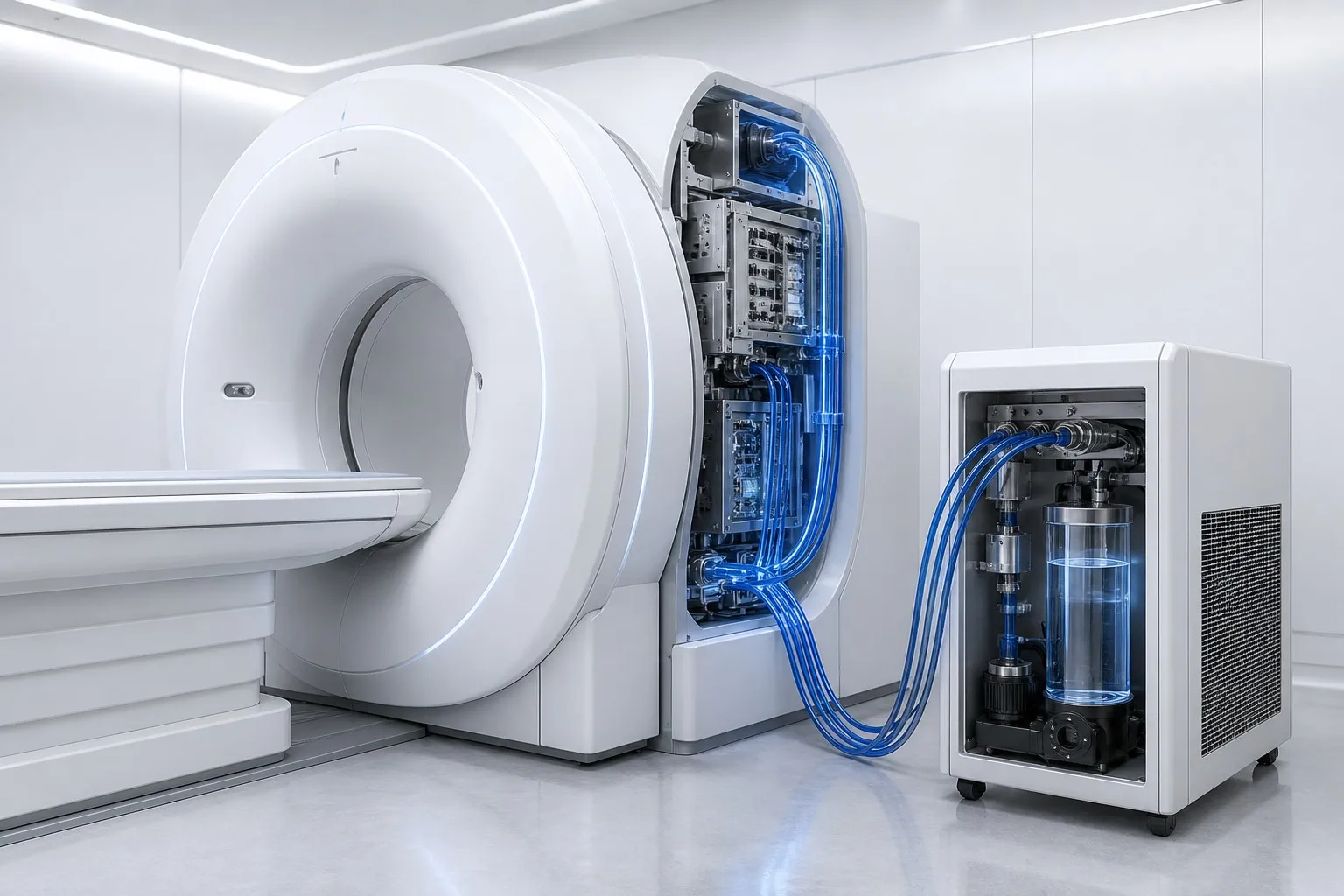
The thermal demands of medical equipment differ from consumer electronics in three fundamental ways. Silence matters: fans are the loudest component in most medical devices, and in an MRI suite, an operating room, or a clinic where patients are already anxious, the roar of cooling fans is not acceptable — because more heat means faster fans. Precision matters: diagnostic accuracy depends on thermal stability — lasers drift with temperature, optical components expand, and sensitive detectors and reagents perform differently when warm, so devices such as protein analyzers, blood purification systems, and precision laser instruments need their components held in a tight temperature window. Reliability matters: medical equipment runs long hours with no tolerance for unplanned downtime, while air cooling moves dust and particulates through sensitive electronics and struggles to remove concentrated heat from dense power modules.
Liquid cooling addresses all three at once. Coolant removes heat directly at the source — through cold plates attached to power modules, lasers, and optical assemblies — instead of pushing air across them. The result is quieter operation, tighter temperature control, and a sealed loop that keeps contaminants away from the electronics it protects.
Applying liquid cooling in medical devices raises the engineering bar well beyond PC water cooling. Leak integrity is a safety requirement: a cooling loop inside or beside patient-facing equipment must be engineered to zero-tolerance standards, with every plate, joint and fitting passing rigorous pressure and air-tightness testing before shipment. Materials must be compatible and durable: medical environments demand corrosion-resistant materials that withstand continuous operation and cleaning protocols without degrading coolant or compromising performance. Thermal precision requires real engineering: delivering ultra-precise temperature control means modeling the system — flow distribution, plate geometry, heat loads — before manufacturing, not tuning it after installation. Quality systems must be verifiable: medical OEMs need suppliers whose quality management is certified and auditable, from incoming materials to finished goods testing.
OCOCOO has manufactured liquid cooling solutions since 2003, and precision medical and laboratory cooling is one of our core application areas. We deliver ultra-precise thermal management for applications ranging from protein chips to blood purification systems, supported by more than 30 national patents and an R&D team that models fluid flow and heat transfer with CFD simulation before a single plate is machined.
Our industrial water cooling boards are produced with vacuum brazing technology to form one-piece plates with high pressure resistance, high reliability, and excellent heat transfer design — engineered for electric power, medical instruments, and other precision equipment. Semiconductor water cooled plates extend the range to laser and photonics applications, while our pumps, radiators, and fittings complete the loop with components matched to your thermal requirements.
Every product is 100% pressure tested before leaving our factory, under an ISO 9001 quality system verified by TÜV Rheinland. With a monthly manufacturing capacity of 50,000 units, we scale from engineering prototypes to production volumes, and our in-house CNC and brazing capabilities support full customization — plate dimensions, port placement, mounting, and finish tailored to your device architecture.
As medical devices grow smarter, denser, and more powerful, the gap between what air cooling can deliver and what precision medicine demands will keep widening. Liquid cooling is the answer that is already working in the most demanding imaging, diagnostic, and therapeutic systems — and it is available to every medical OEM willing to engineer it properly.
Contact OCOCOO today to discuss liquid cooling for your medical device — from cold plate design to complete thermal loop integration.
