


The case for liquid cooling is settled. What remains open — and what separates a successful deployment from an expensive lesson — is reliability. Industry reporting continues to cite Uptime Institute data placing water and coolant events among the top five root causes of unplanned data center outages worldwide, a ranking that has held consistently rather than appearing as an occasional anomaly. The Open Compute Project's liquid cooling guidelines address the same risk directly, setting an annual cold plate and coolant loop failure rate of 0.3% or lower as a design and operational target. In other words, the industry has already decided that reliability is not a feature to add later; it is an engineering discipline to design in from the start.
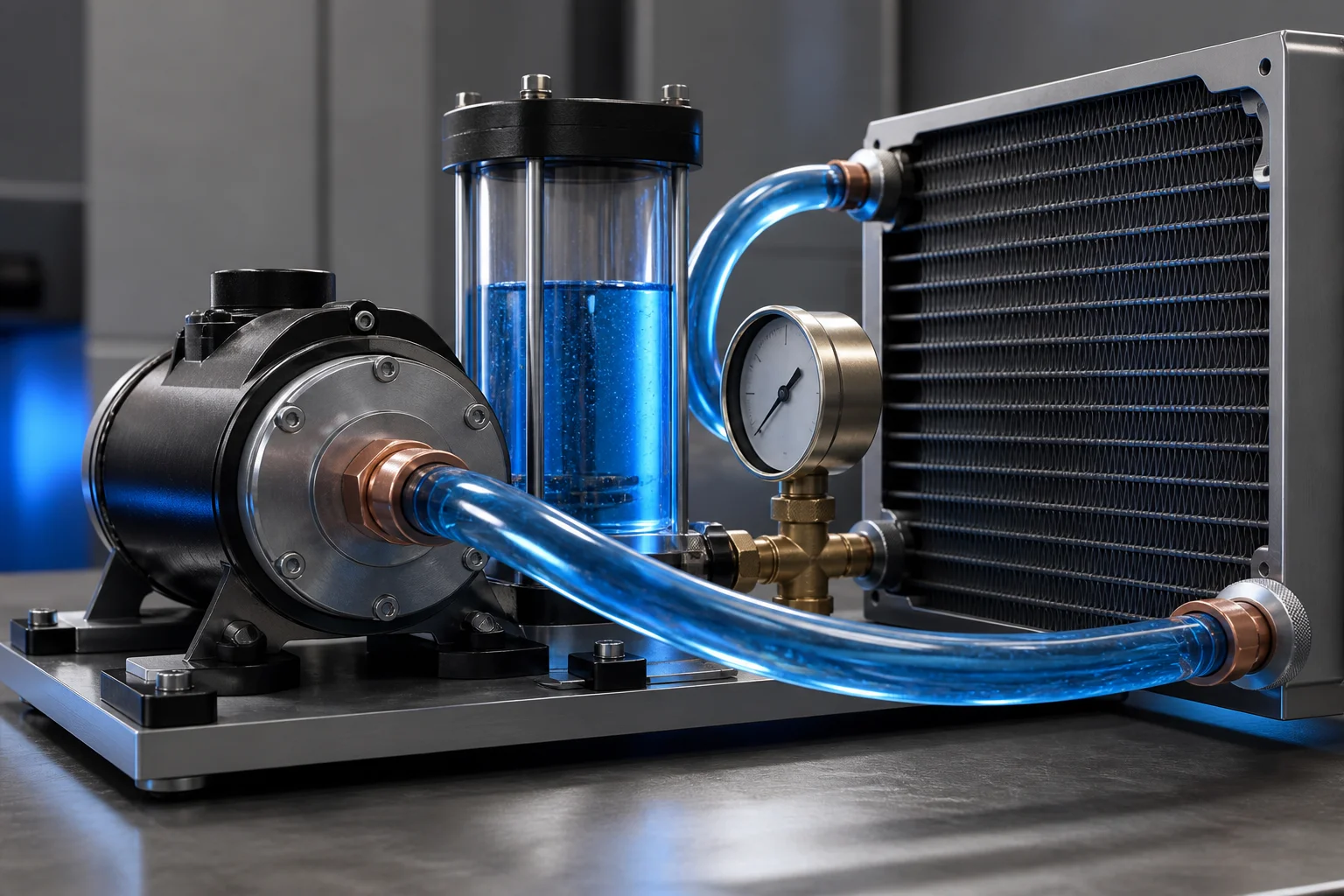
Leaks. As industry analysis of leak testing has noted, liquid cooling systems bring pumps, fittings, seals and heat exchangers into close interaction — and any weak point can compromise the entire system's performance. A small leak does not stay small in consequence: coolant can reach servers, networking hardware, or power supplies. Corrosion-driven leaks are especially insidious because they develop over months of operation rather than appearing during commissioning. Manufacturers of thermal management systems describe the mechanism plainly: leaks caused by corrosion or fluid interconnect issues reduce efficiency, damage components, and raise maintenance costs.
Coolant degradation. The fluid itself is a wear item. As reported in the industry, glycol-based solutions can cause corrosion over time, while dielectric coolants that leak can reduce insulation effectiveness or contaminate electronics. Industry guidance from ASHRAE identifies coolant cleanliness as a key requirement for reliable direct-to-chip operation — which means ongoing maintenance and monitoring to prevent fluid deterioration from damaging servers and infrastructure.
Gradual performance loss. Not every failure announces itself. Restricted flow, fouled channels, and degraded seals raise thermal resistance long before a system faults, quietly pushing components closer to their thermal limits under sustained load.
Reliability is decided long before the first drop of coolant enters the loop. Material compatibility: copper and aluminum behave differently in a shared fluid circuit, and the wrong pairing accelerates corrosion — specify materials as one system, including plates, fittings, radiators, and pump internals, not as a parts list. Joint and seal engineering: every connection is a potential leak path, and brazed, one-piece construction eliminates many of them at the source, while mechanical joints need engineered sealing and verified torque. Pressure and air-tightness testing: component-level testing catches defects that no amount of assembly care will fix, so every cold plate and loop sub-assembly should be pressure tested before it leaves the production line. Thermal and flow modeling: CFD simulation reveals uneven flow distribution, dead zones, and hotspots while they are still design drawings — the cheapest possible stage to correct them.
Once deployed, reliability depends on what you monitor and what you maintain: coolant condition and cleanliness per manufacturer and operating guidance, leak detection coverage across racks and secondary loops, flow, temperature and pressure baselines that reveal drift, and scheduled inspection of fittings, filters, and pumps. Programs built around these practices are how operators convert the 0.3% failure-rate target from an aspiration into an operating result.
OCOCOO has manufactured liquid cooling components since 2003 and holds more than 30 national patents, with an engineering team that validates flow and thermal performance through CFD simulation and thermal modeling. Our industrial water cooling boards are manufactured with vacuum brazing to form one-piece plates rated for high pressure resistance and long service life, and semiconductor water cooled plates extend the same approach to laser and photonics applications.
Every product is 100% pressure tested before shipment under an ISO 9001 quality system verified by TÜV Rheinland. Monthly manufacturing capacity of 50,000 units supports production volumes, while in-house CNC and brazing capability enables customization of dimensions, port types, mounting, and finish. For loops that need to run for years — not quarters — that combination of design validation, tested construction, and auditable process control is where reliability actually comes from.
Contact OCOCOO to discuss your reliability requirements, request specifications, or explore custom cold plate design for your liquid cooling system.
