


Graphics power ratings are not coming back down. Reporting on the 2026 hardware landscape notes that GPUs such as NVIDIA's H100 and H200, rated at around 700W, are already stretching conventional air-cooling limits, with the next server platforms pushing further still. Research from IDTechEx points to GPU TDP surpassing 1500W, and observes that single-phase direct-to-chip cooling begins to struggle at around 1500W, with 2000W treated as its practical upper limit.
Those figures describe data center silicon, but the curve reaches desktop and workstation hardware too. Enthusiast and professional graphics cards continue to lift their power ceilings generation over generation, and every watt of that budget leaves the die as heat that has to go somewhere.
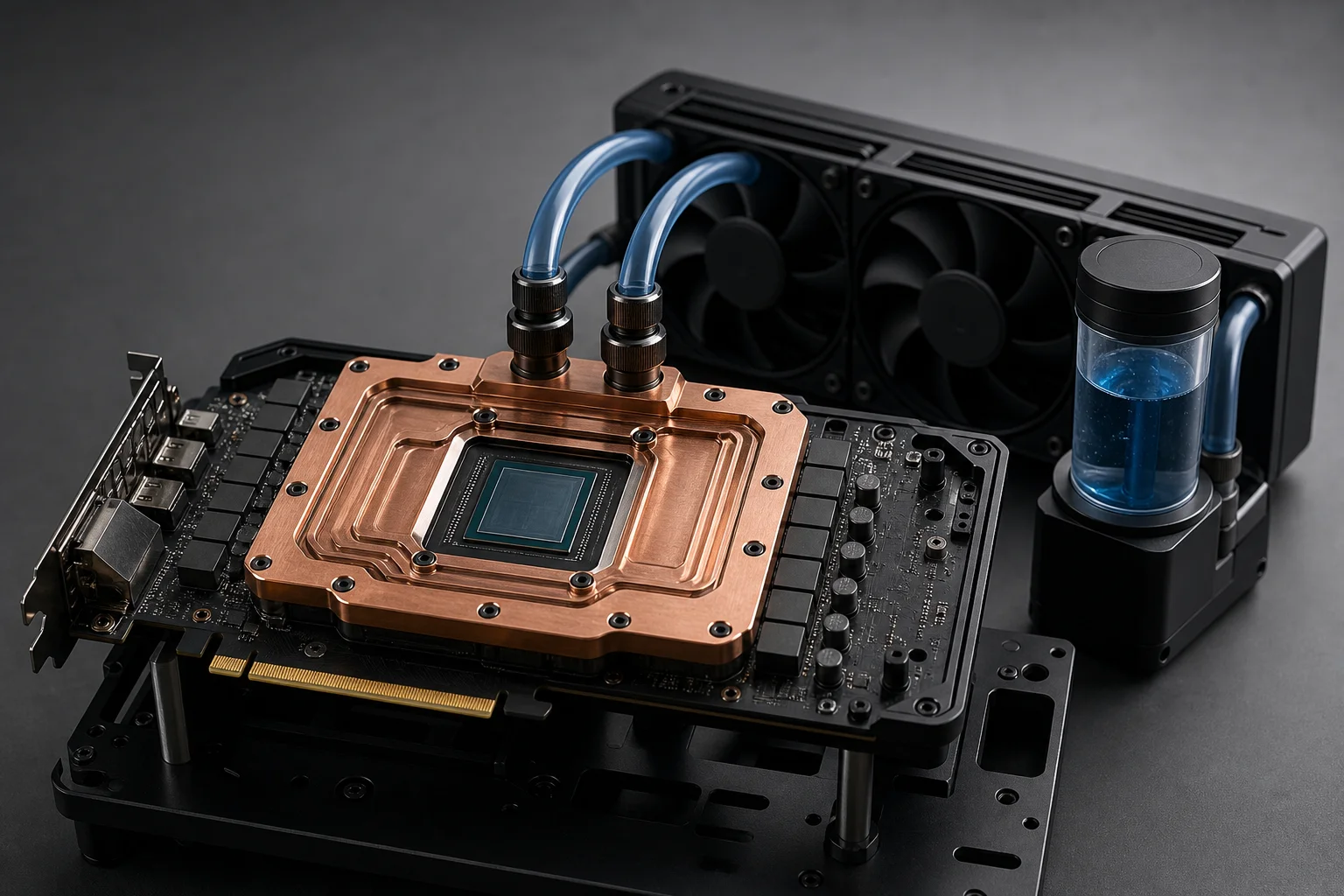
Air cooling has served desktop graphics well for two decades, and it still works — up to a point. The problem is geometric. A graphics card cooler has to shed its heat into a chassis, which means its performance depends on case airflow, ambient temperature, and how much space is left around the card once it is installed.
As thermal loads rise, air coolers answer with more fin volume, more fans, and more weight. That approach hits three walls at once: heat sink mass becomes a mechanical load on the PCB and the slot, fan noise climbs as RPM rises, and in multi-GPU workstations the top card is fed by air that the card below has already heated.
Virtualized workloads make the trade-off worse. A card running inference, rendering, or simulation load for hours at a time does not benefit from a cooler tuned for short gaming bursts — it needs a thermal design that holds steady indefinitely.
Liquid cooling is not one product; it is a family of architectures that solve different constraints.
All-in-one (AIO) loops replace the card's air cooler with a water block and a factory-sealed loop to a radiator. Installation is straightforward and the noise profile improves, but the radiator mount is limited to standard 120 mm / 240 mm / 360 mm footprints — which caps how much thermal capacity you can actually add.
Custom split loops let the designer choose the radiator area, fan configuration, pump, tubing and block independently. That freedom matters when one radiator is not enough: a 360 mm copper radiator can be supplemented by a second radiator, or by a larger externally mounted one, without changing the cards themselves.
External radiators move heat rejection completely outside the chassis. For multi-GPU workstations and quiet systems, this is often the decisive option: internal airflow stops being the limiting factor, and the radiators can be sized for continuous duty rather than for whatever space the case has left.
Once you move to liquid, the design questions change. The list that determines whether a loop performs for years:
OCOCOO has manufactured liquid cooling components since 2003 and holds more than 30 national patents. Loops are developed with CFD simulation and thermal modeling to validate flow distribution and heat transfer before tooling is cut, and the range covers copper radiators, high-flow pumps, GPU and CPU water blocks, external radiator systems and fittings.
Every product is 100% pressure tested before shipment under an ISO 9001 quality system verified by TÜV Rheinland, with monthly capacity of 50,000 units supporting volume programs. For workstations, OEM builds and industrial systems, dimensions, port types, mounting and finish can be customized to the chassis and workload.
Contact OCOCOO to discuss your GPU cooling requirements, request specifications, or start a custom cold plate and radiator design.
