


Liquid cooling is no longer a single technology choice. Operators now weigh two dominant paths: cold plate (direct-to-chip) and immersion. Both move heat with liquid instead of air, but they differ sharply in how they fit a facility, a server fleet and a maintenance team.
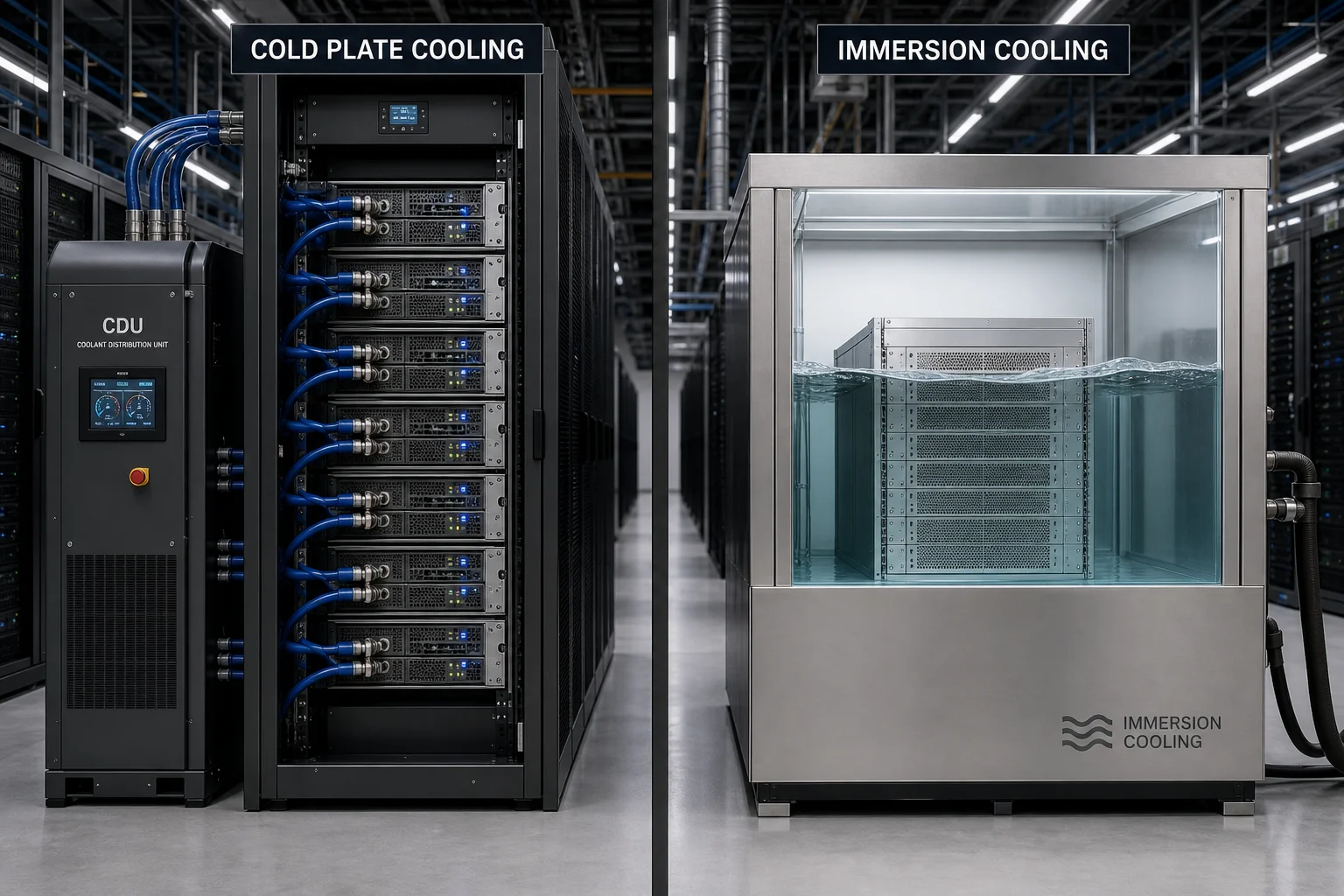
The industry consensus has been settling on one of them first. Market analysis published in July 2026 describes direct-to-chip cooling as becoming the leading liquid cooling method for AI servers, because it removes heat directly from the hottest components. Earlier reporting on the thermal roadmap reached a similar conclusion: as of late 2025, single-phase direct-to-chip cooling remained the dominant solution for high-end GPU thermal management, while thermal design power continued to climb. Broader market research in August 2026 framed the shift as a move away from air toward direct-to-chip, immersion and in-package microfluidic cooling as accelerator power levels scale.
A cold plate is a machined metal block with internal channels. It mounts directly on a CPU, GPU or other hot component, and coolant flowing through it carries heat away to a coolant distribution unit and then to a facility loop or dry cooler. The approach integrates with existing rack and server platforms, which is why it typically offers the shortest path from an air-cooled fleet to liquid cooling.
Its strengths are retrofit fit, serviceability and a mature supply chain. A technician can still swap a server, a hose or a cold plate without draining an entire tank. The trade-offs are coverage and residual heat: cold plates capture the highest-density components, while memory, power supplies and other board-level heat still need airflow or secondary cooling.
Immersion places entire servers in a tank of dielectric fluid. Heat transfers from every surface into the liquid, so there are no fans, no hot spots on the board and no dependence on airflow paths. Density and temperature uniformity are the main arguments, and acoustics improve because fan noise disappears.
The trade-offs are operational. Fluid is a consumable with its own supply chain and cost profile. Servers may need modification, and the maintenance workflow changes: components are handled wet, tanks are opened with care, and fluid chemistry has to be monitored over time. Facility design, floor loading and fluid handling all need planning before the first tank is installed.
Many facilities end up with both: cold plates for the highest-density AI rows and immersion where density and noise justify dedicated tanks.
Whichever path is chosen, cold plate performance depends on the parts inside it. OCOCOO has manufactured liquid cooling hardware since 2003, holding more than 30 patents and using CFD simulation and thermal modeling to design and verify internal channel layouts before production. Cold plates are joined with vacuum brazing for pressure resistance and long-term reliability, and every unit passes pressure testing before shipment.
That process control is backed by an ISO 9001 quality system verified by TÜV Rheinland, alongside electromagnetic compatibility and safety compliance testing. Monthly capacity reaches 50,000 units, and customization covers dimensions, port types, mounting patterns and finishes — so a cold plate can be matched to a specific board, chassis and facility loop rather than forced into a standard size.
Compare both paths against your own density target, room layout, maintenance staffing and fluid strategy before committing capital. Whichever route the numbers support, the cold plates, coolants and system-level integration need to be engineered for years of continuous operation, not just for a launch specification.
To discuss cold plate requirements, customization options or technical documentation for your next deployment, contact the OCOCOO engineering team with your thermal targets and mechanical constraints.
