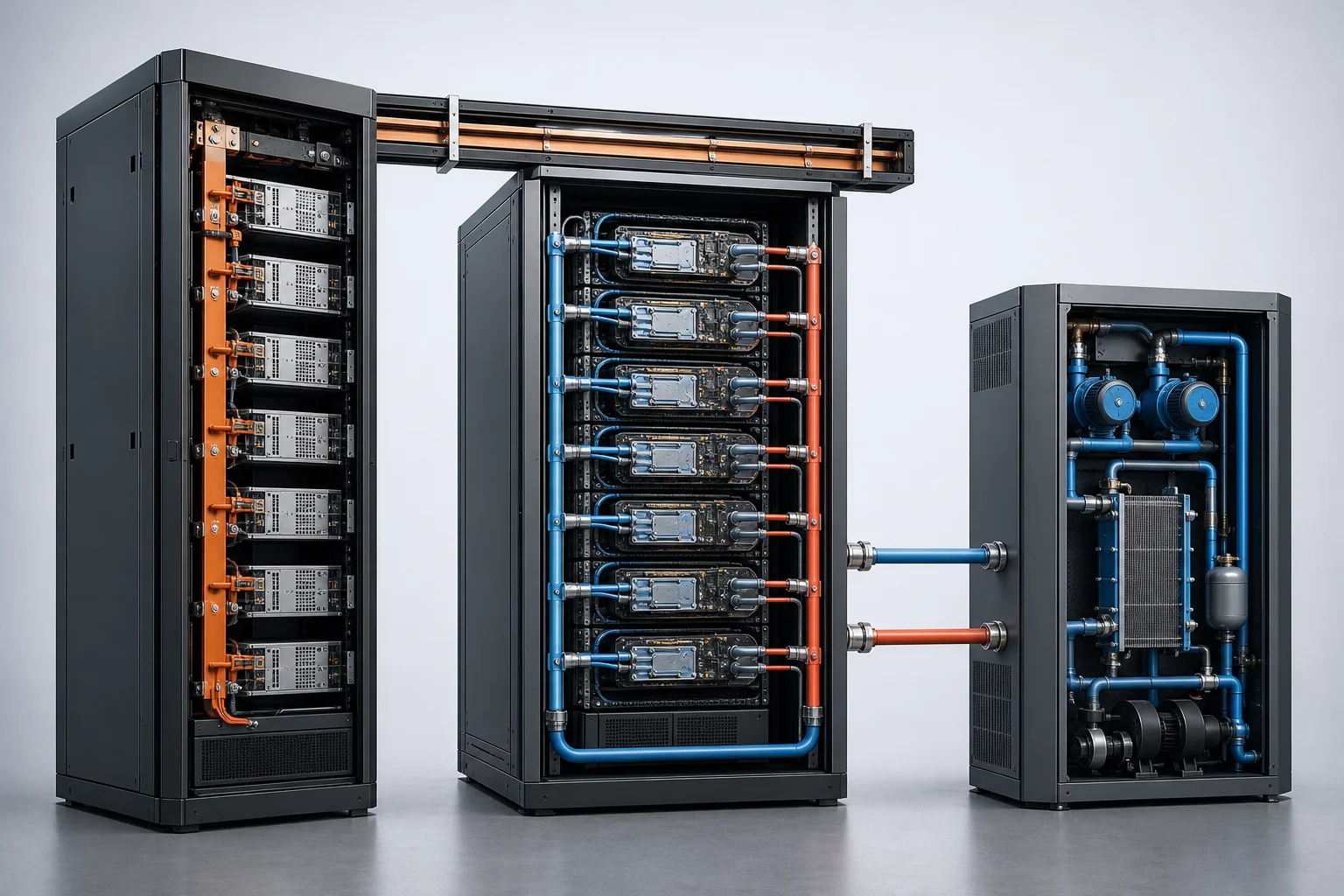
High-density compute boards have pushed air cooling to its limit. Once a board draws several hundred watts across a small area, more fans stop helping, because the limit is no longer airflow but the thermal path between chip and air. A cold plate replaces that path with liquid — and it is the one component in the loop that every other choice depends on.

| Parameter | Value |
|---|---|
| Model | 1346 water cold plate |
| Item No. | 00225 |
| Material | Aluminum |
| Connection type | Pneumatic connector |
| Connector outer diameter | 8 mm |
| Plate size | 256 mm x 159.5 mm x 17 mm (L x W x H) |
| Net weight | 4.65 kg |
| Typical application | Avalon 1346 water cooling system |
Because it is sized for the Avalon 1346 hash board, this plate shows how an industrial cold plate is specified in practice: not a universal part, but a plate cut to a known footprint. At 256 mm by 159.5 mm it matches the board it serves, and the 17 mm height leaves room for the coolant channel and connector body without exceeding the clearance available in a mining frame or rack.
The construction is all aluminum. That choice matters twice over: it holds the net weight to 4.65 kg, and it resists corrosion inside a wet loop. In continuous operation, the failure mode that takes a cooling plate out of service is rarely one hot day but slow corrosion and the deposits that follow — which is why material selection and coolant chemistry belong in the same conversation.
Copper has the higher thermal conductivity, and there are applications where that decides the design. For a plate of this size, the trade-off usually lands elsewhere. Aluminum is lighter, more economical at scale, and easier to machine into large, flat bodies with consistent channel geometry. The engineering work that closes the performance gap sits in the internal channel layout: enough wetted area over the hot spots, and a flow path that keeps pressure drop within what the pump and the rest of the loop can deliver.
That is where CFD simulation earns its place. Modelling the plate before tooling shows whether flow distributes evenly across the board footprint or short-circuits along the easiest path — far cheaper to fix on screen than in a brazing fixture.
Every joint in a liquid loop is a potential leak, so connector choice is a reliability decision rather than a convenience one. The 1346 uses a pneumatic connector that takes 8 mm outer diameter pneumatic tubing — widely available, quick to connect and release, and easy to service in the field, which keeps maintenance simple for operators running several boards in a frame. The trade-off is discipline: the fitting is only as good as the tubing cut and the insertion depth, so a documented assembly procedure matters as much as the part itself.
Two details decide whether a plate fits a project:
If a project needs a different footprint, plate thickness or connector type, cold plates are usually adapted rather than replaced with an off-the-shelf alternative, and OCOCOO accepts custom configurations through its inquiry channel.
OCOCOO has produced water cooling components since 2003 and holds more than 30 patents in water cooling technology, with annual R&D investment rising by roughly 20 percent year on year. For industrial water cooling boards, the company uses vacuum brazing to form the plate in one piece — supporting high pressure resistance and high reliability while reducing the joints that can leak.
Quality control follows the same logic. The facility is ISO9001:2015 certified with a monthly capacity of 50,000 units, work is verified by TÜV Rheinland, and every unit undergoes 100 percent pressure testing, with air-tightness verified to 0.2 MPa. Plates are designed to be leak-proof over the service life of the equipment, not merely to pass an initial test.
Hash boards and mining rigs are the obvious application for the 1346, but the same plate class serves electric power equipment, medical instruments, beauty instruments, UV printers, UAVs and self-driving car platforms. In each case the requirement is similar: a flat, sealed body that pulls heat out of a dense electrical load and hands it to a liquid loop, in a package that can be serviced without dismantling the whole assembly.
A short checklist for a new project:
For a quotation, custom plate design or help matching a cold plate to a specific board, send an inquiry with your drawing and thermal requirements and the engineering team will respond directly.
 OCOCOO OC-TD-01 Semiconductor Water Cooled Plate: Welded Aluminum Cold Plate for Chip Packages