Power architecture is usually treated as an electrical problem, discussed in busbar ratings and conversion efficiency. In practice it lands on the thermal engineer's desk, because the voltage a rack runs at sets how much compute can be packed into it, and density is what decides whether air or liquid carries the heat away. The move to 800 VDC is the clearest example yet.
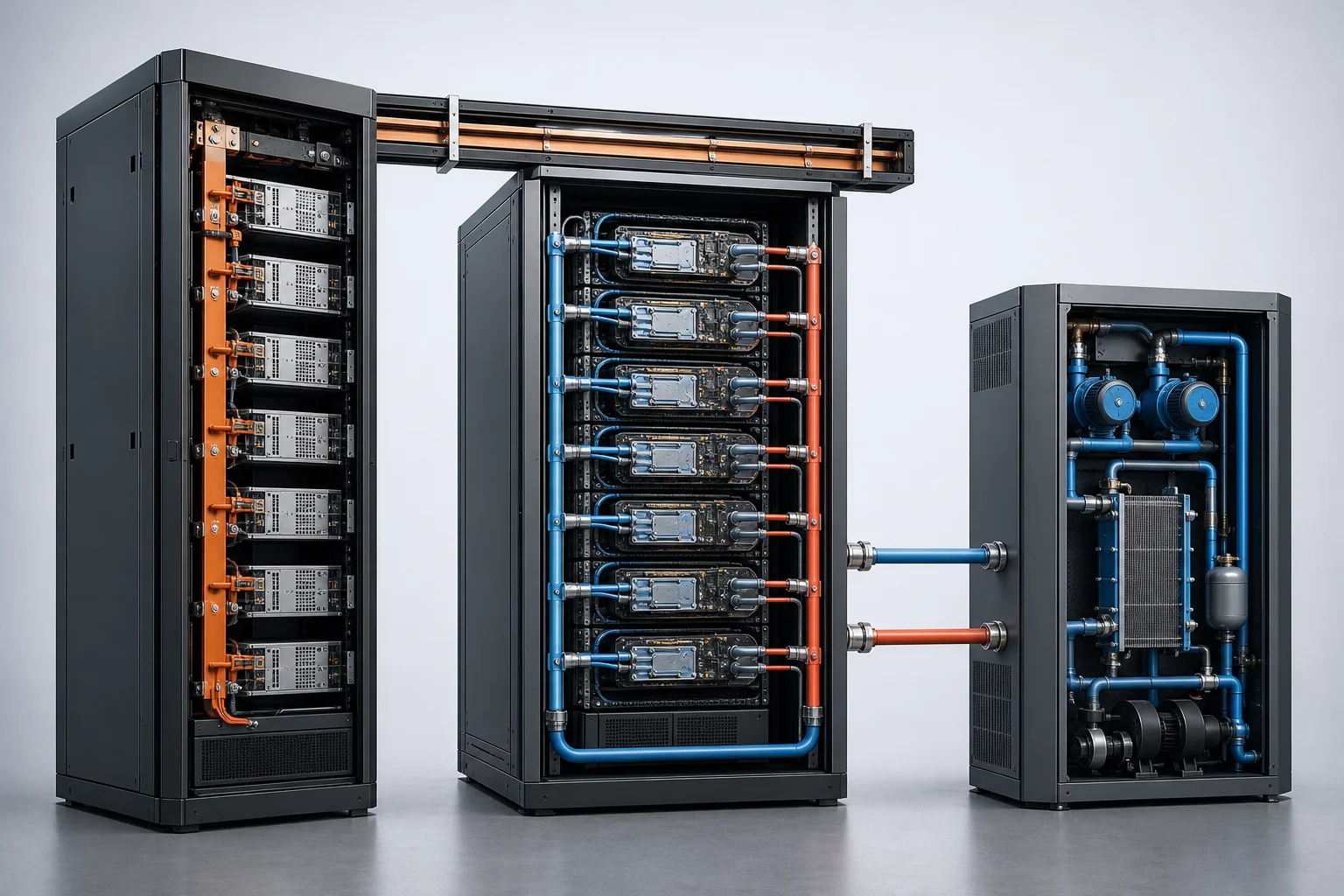
NVIDIA's own framing of the problem is that the constraint is not wattage but how power travels: “In traditional power delivery, electricity travels from the grid as an alternating current (AC) and gets converted multiple times, each time adding overhead and complexity as racks become denser.” Distributing at 800 VDC removes conversion stages between the grid and the accelerator, so a larger share of the available power reaches compute — and more compute in the same footprint means more heat in the same footprint.
This is no longer a roadmap item. NVIDIA states that its MGX-compatible 800 VDC power rack arrives in the second half of 2026, designed to “slot into existing AC infrastructure and deliver 800 VDC to compute racks within the row — no changes to the building's electrical system required.” The specification work has been done through the Open Compute Project, and more than 80 equipment manufacturers are building products to it.
Delta's GTC 2026 announcement gives a concrete picture of the hardware that follows. Its 800 VDC in-row power racks carry 660 kW with embedded 80 kW battery backup units per shelf, 480 kW in total, and AC-DC efficiency as high as 98%. Alongside them sit in-row coolant distribution units rated at 3,000 kW and 2,400 kW, the latter supporting 800 VDC with an N+1 pump design.
Two things stand out. First, power and cooling are now specified as one unit for the row, not as separate disciplines that meet in a plant room. Second, the CDU capacities are measured in megawatts — an order of magnitude above what a single rack loop needed a few years ago. NVIDIA's roadmap goes further, with a row power centre supporting up to 2 megawatts per row expected in 2027.
In an air-cooled row, almost all the heat comes from the compute. Once conversion moves into the row, the power shelves become a second, substantial heat source sitting metres from the accelerators — and they have their own temperature limits, which are usually tighter than the coolant loop's.
That shifts the thermal design question. It is no longer “how do we cool the GPU”, but “how do we reject heat from two sources with different limits through one loop, without letting the cooler of the two dictate the flow rate for both”. In practice this leads to parallel branches with their own balancing valves, and to a supply temperature chosen to satisfy the most sensitive branch rather than the largest one.
Air has a fixed heat capacity per cubic metre, and moving enough of it through a rack at this power level costs fan energy, floor space and noise. Liquid carries far more heat per unit volume through a pipe that takes no rack units. The consequence is simple: above a certain rack density, the choice is not between air and liquid but between liquid and not deploying.
Four items carry most of the risk when a row is upgraded.
The cold plate sets how warm the coolant can run for a given junction temperature. Higher coolant temperatures reduce the load on the facility side and make heat rejection easier; the limit is the plate's thermal resistance. This is where simulation before tooling pays for itself.
The manifold becomes a larger pressure drop as more branches are added, and a larger leak surface. Dripless couplings and tested assemblies matter more at 3 MW than at 30 kW.
The CDU pump set needs N+1 because there is no graceful degradation at this scale — as Delta's 2,400 kW unit illustrates, redundancy is now designed in rather than added later.
Fittings and tubing must be rated for the flow and the coolant chemistry the loop actually sees, not the values on a legacy drawing.
OCOCOO has manufactured water cooling components since 2003 and holds more than 30 patents in water cooling technology. Designs are modelled with CFD and thermal simulation before tooling, verified by TÜV Rheinland, and built in an ISO9001:2015 certified facility with a monthly capacity of 50,000 units. Every unit undergoes 100 percent pressure testing, with air-tightness verified to 0.2 MPa, and components are engineered to be leak-proof over the service life of the equipment. The portfolio covers cold plates, radiators, pumps, water blocks and fittings, so a row-level loop can be sourced in one place.
For a quotation on cold plates, manifolds or a complete loop for a high-density row, send an inquiry with your rack power, coolant temperatures and flow targets, and the engineering team will respond directly.
 OCOCOO OC-TD-01 Semiconductor Water Cooled Plate: Welded Aluminum Cold Plate for Chip Packages

